The Impact of Emily Bush's Leadership at Bike/Walk Central Florida
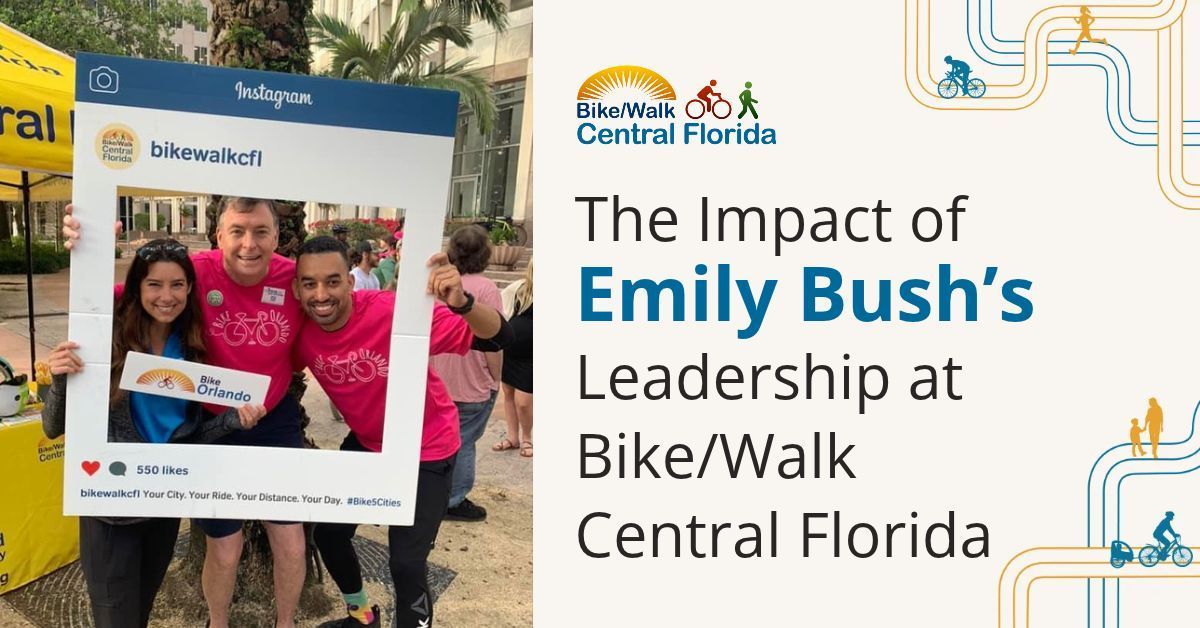
In March 2020, Emily Bush stepped into the role of Executive Director just as the world shut down. Schools closed, offices emptied, and almost overnight, Central Florida’s sidewalks and trails filled with people. Families walked together after dinner. Kids rode bikes on streets that had felt once off-limits. Neighbors who had never thought of themselves as cyclists dusted off old bikes in the garage.
That surge was encouraging, but it also raised real concerns. Central Florida has long ranked among the most dangerous places in the country to walk, and more people outside meant more people at risk. Emily saw both the opportunity and the urgency, and she spent the next six years building an organization equipped to meet them.
Today, BWCF has grown from a small grassroots nonprofit into a regional organization with programs in classrooms, on trails, and at crosswalks across eleven counties. That growth shows up in the places it matters most: more crosswalks where drivers stop, more students who know how to get around safely, and more communities planning for people instead of just cars.
Gathering a Team Built for the Work
Emily understood that safer streets take years of steady work, and that BWCF would need the people and resources to sustain it. When she became Executive Director, BWCF was a one-person operation. Over the next six years, she grew the team to 13, bringing on program leaders, coordinators, and outreach staff who could work directly with communities across the region. As the team grew, so did what BWCF could take on. Best Foot Forward expanded into new counties, SAFE Travelers could reach thousands of students, and the organization began planning and participating in coalition work it had never done before.
She approached funding the same way, building a base of support that could carry the organization over the long term. Government partners such as the Florida Department of Transportation (FDOT), Orange County Government, and regional transportation planning organizations invested in programs like
Best Foot Forward and
SAFE Travelers. Private and philanthropic partners, including Dr. Phillips Inc., the Foundation for a Healthier West Orange, Orlando Health, and AdventHealth, saw the value in that work and chose to support it as well. With their help, BWCF’s annual budget grew from $265,000 to $1.2 million in under five years, giving the organization the stability to plan ahead and commit to work that takes time to come into fruition.
Making Crosswalks Safer
In Central Florida, an average of three people are injured every day, and at least one person is killed every week simply trying to cross the street. Fourteen percent of those deaths happen in marked crosswalks, the very places people should be safest.
Best Foot Forward, the nation’s largest pedestrian-focused grassroots coalition, works to change that by focusing on one behavior: getting more drivers to stop for people crossing, as Florida law requires. The program pairs high-visibility enforcement with local law enforcement, low-cost engineering improvements, and community education, and backs it all with careful evaluation. Its enforcement operations focus on education and long-term behavior change rather than punishment, because the goal is lasting change, not tickets.
When Emily became Executive Director, Best Foot Forward served three counties: Orange, Osceola, and Seminole, as well as the City of Orlando. Under her leadership, the program grew into a model that partners across the state wanted in their own communities. Through new partnerships with the FDOT and regional transportation planning organizations, Best Foot Forward expanded to Brevard, Volusia, and Marion counties in 2024; Lake, Polk, and Flagler in 2025; and Duval and St. Johns in 2026. In just three years, the coalition grew from three counties to eleven.
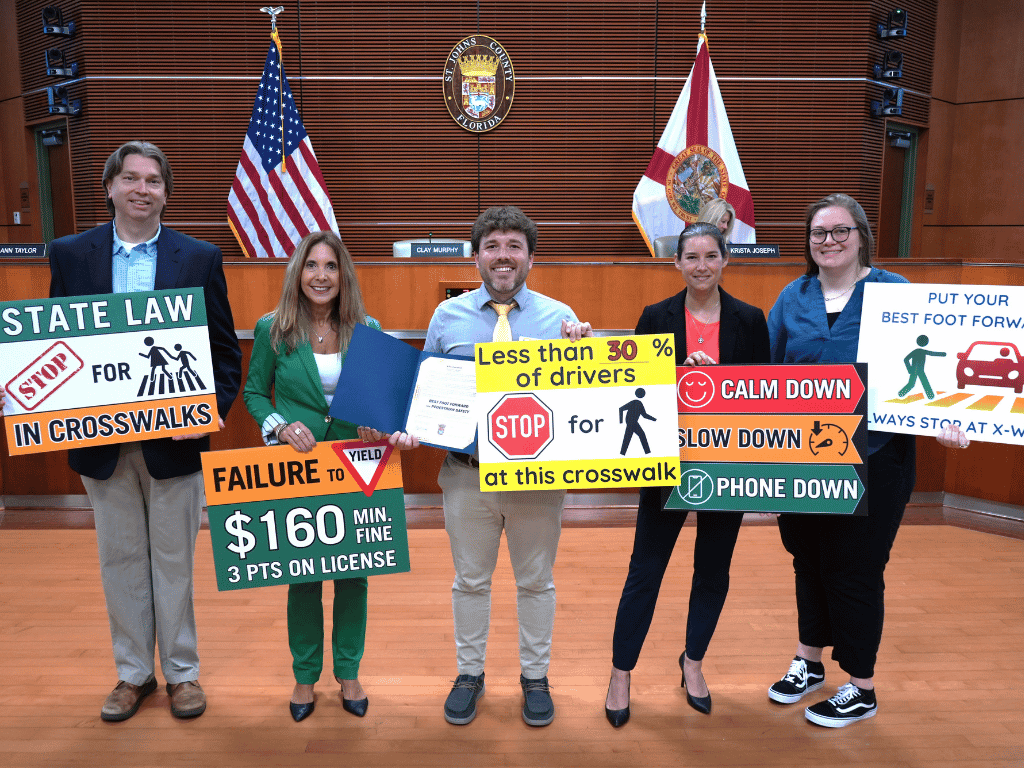
Michael Likely (Project Manager for St. Johns County Public Works Department), Ann Taylor (St. Johns County Vice-Chair Commissioner, District 5), Vince Dyer (Best Foot Forward Program Director), Emily Bush, McKenzie Anderson (Best Foot Forward Program Coordinator) at the St. Johns County proclamation.
Growing that quickly meant rethinking how the program worked. BWCF created activities that asked community members what they knew about Florida’s driver yield law, opening up conversations with people who might never have thought about it before. Working closely with local media helped carry that message well beyond the crosswalk, reaching drivers BWCF could never meet in person. And by streamlining enforcement operations, BWCF made it easier for law enforcement partners to take part consistently, year after year.
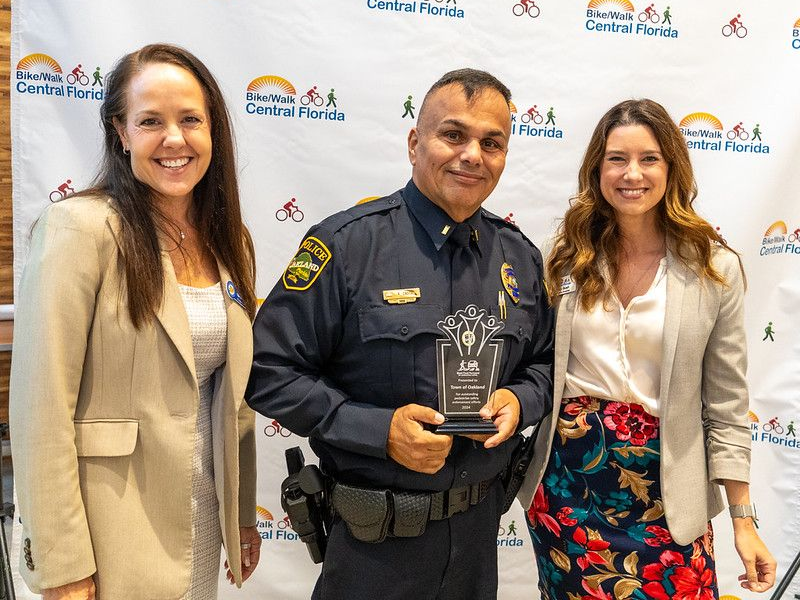
Nicole Wilson (Orange County Commissioner), R. Castro (Oakland Police Department), and Emily Bush at the 2024 Best Foot Forward Pedestrian Safety Summit.
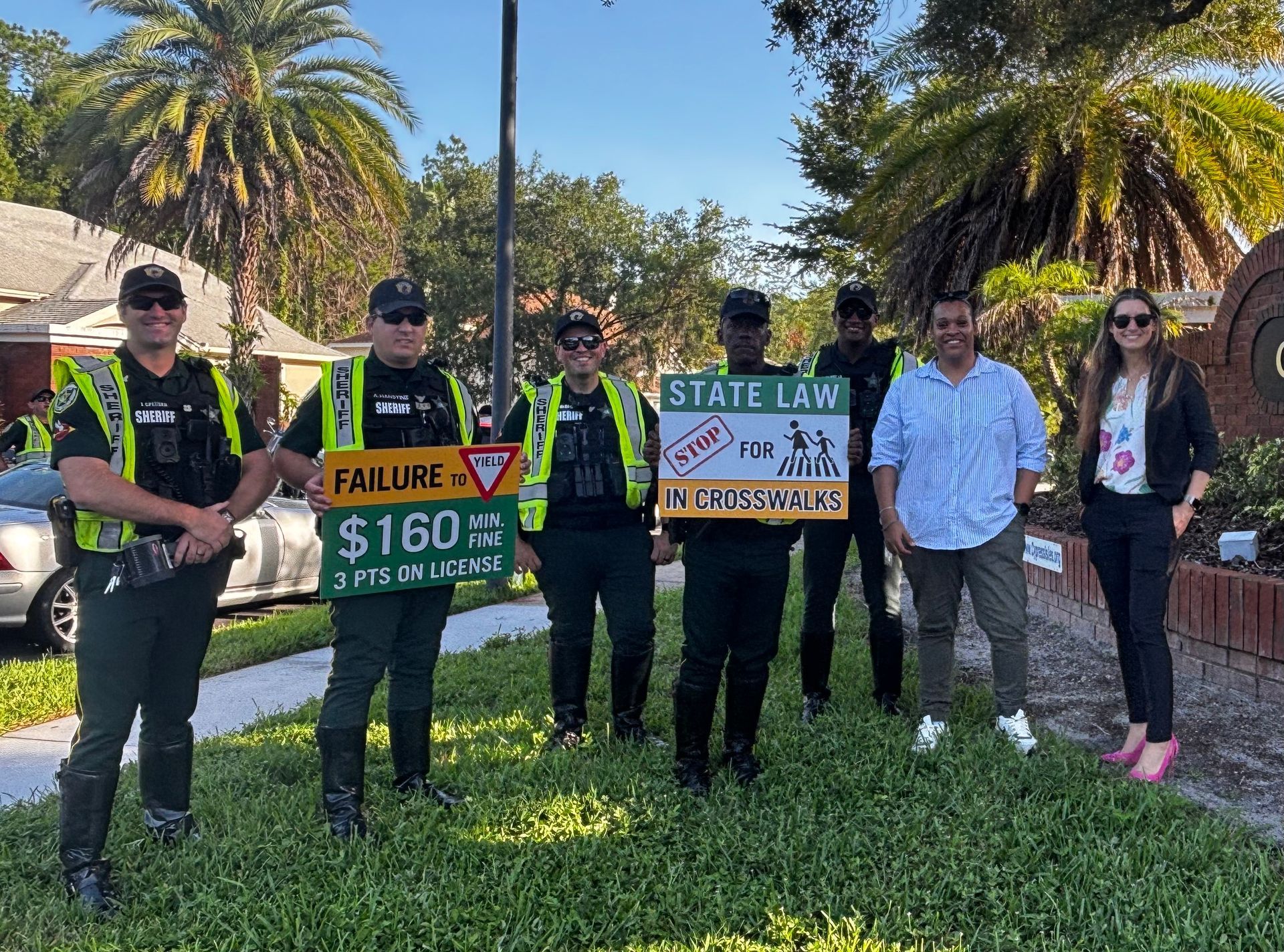
Orange County Sheriff’s Office, Wendy Reyes (Assistant Project Manager, Orange County Government), and Emily Bush at Operation Best Foot Forward 2026.
Behind the scenes, BWCF digitized the program’s data collection. Instead of working from paper forms and spreadsheets, staff could record observations right at the crosswalk, and partners could see results in real time. That made it easier to share progress, respond quickly when something wasn’t working, and keep everyone on the same page across a growing number of counties.
With consistent data coming in from more crosswalks and more counties, BWCF could start looking at trends across the entire program for the first time. Instead of treating each crosswalk on its own, the team could see patterns: which low-cost improvements made the biggest difference, which types of beacons drivers responded to most, and how consistent enforcement needed to be to create lasting change. That gave partners clear guidance on where to invest next.
Across the program, average driver yield rates at monitored crosswalks have climbed from 17% to 50%, meaning more people making it safely to the other side.
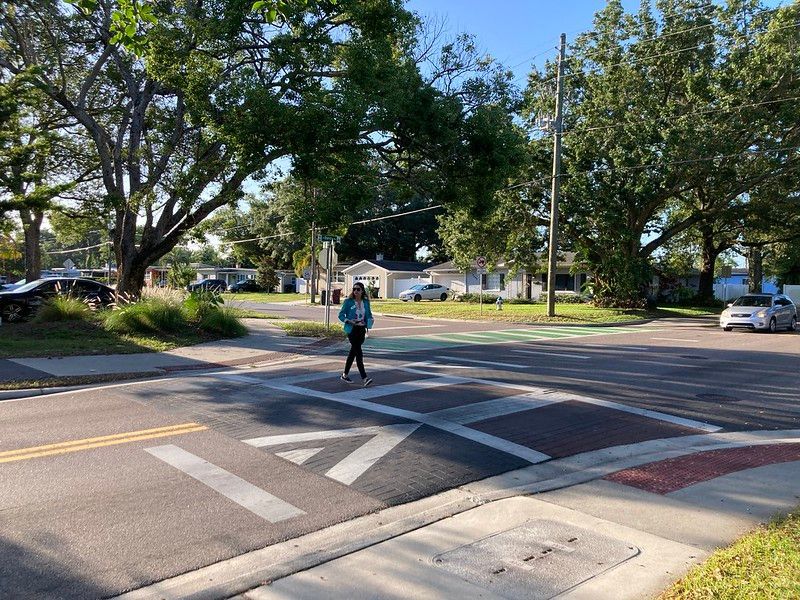
Emily Bush as a decoy walker for Operation Best Foot Forward in 2022.
With each new county, Best Foot Forward brings what it has learned to more crosswalks and more communities, working toward a day when stopping for people in the crosswalk is simply what drivers do.
Building Confident, Independent Young Travelers
As BWCF grew, it saw a clear gap: young people in Central Florida had little access to traffic safety education. Many students walk, bike, or roll to school and around their neighborhoods, yet few had ever been taught how to do it safely.
BWCF built its youth education program from the ground up, and it all started with Cornerstone Charter School. When the school asked BWCF to host a bike rodeo, BWCF invited FDOT, Orange County, and other partners to join. That success led FDOT and Orange County to ask for help launching a walking school bus at Pineloch Elementary, which BWCF developed and piloted with a class from the University of Central Florida. One of those students, McKenzie Anderson, went on to join BWCF and now serves as Best Foot Forward Program Coordinator!
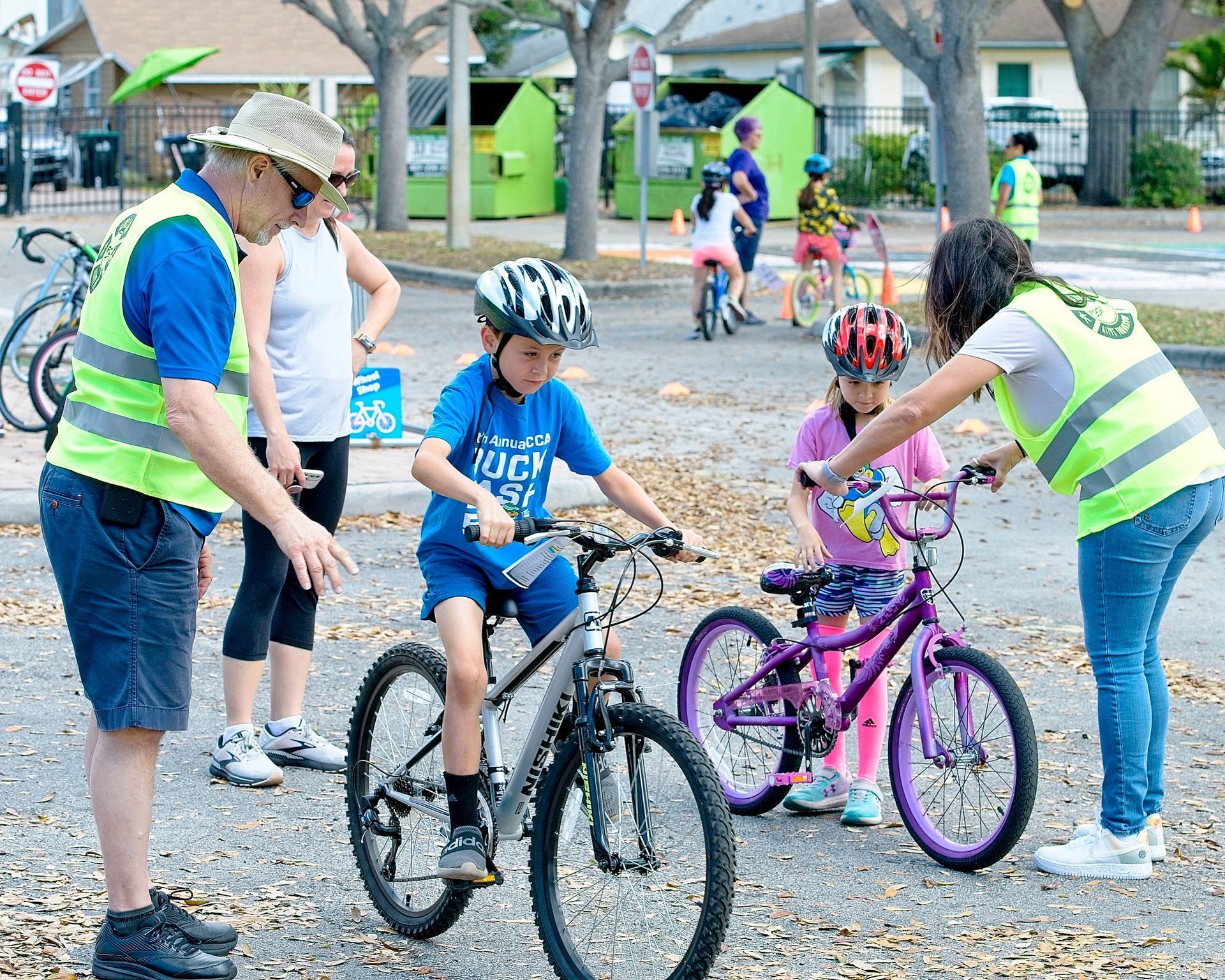
2022 Cornerstone Bike Rodeo.
From there, requests for bike rodeos and safety education kept coming. BWCF partnered with OBT Next and the Orange Blossom Trail Community Redevelopment Agency to launch Rollin’ and Strollin’, an annual community bike rodeo, and began shaping these activities into a structured curriculum, learning from successful programs around the state and the needs it saw in local communities.
One need stood out. More and more students were showing up on e-bikes and e-scooters, often without ever being taught how to ride them safely. BWCF made micromobility safety a key part of the curriculum, recognizing the risk before it showed up in the data.
A study published in JAMA
has since confirmed the concern, finding that children hurt on e-bikes were twice as likely to suffer serious injuries as those on regular bikes, and 1 in 10 had a brain injury.
In 2024, BWCF formally launched the youth program with support from FDOT District 5, EXP, Orange County, and Orange County Commissioners Nicole Wilson and Christine Moore. By its second year, Orange County Government committed $50,000 in annual funding, and the program became a regular part of programming in Orange County Public Schools, offering classroom presentations, bike rodeos, helmet fittings, and bike giveaways for kids who need them.
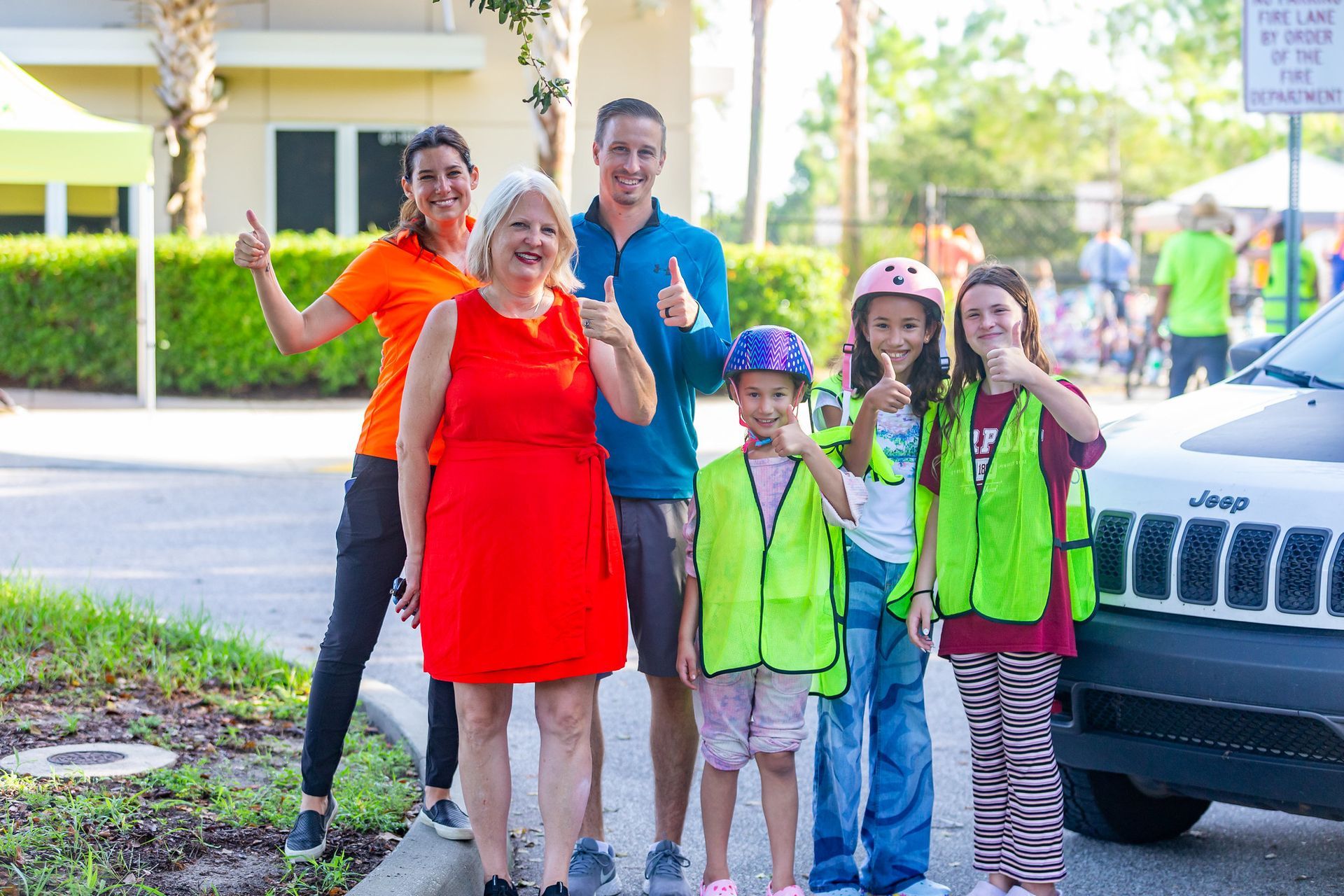
Emily Bush with Orange County District 2 Commissioner Christine Moore at the 2024 Back to School Bash & Bike Rodeo.
In 2026, the program took on a new name: SAFE Travelers Youth Program. SAFE stands for Smart, Active, Fun, and Empowered, and the program gives students from elementary through high school the skills and confidence to travel on their own.
Today, SAFE Travelers operates in five counties. Since its launch, the program has reached more than 10,800 students, distributed more than 5,100 helmets and 1,650 bikes, and hosted 56 community events. In the last year alone, it served 5,300 students, and demand from schools and communities continues to grow.
From Advocacy to Action
For years, BWCF advocated for streets and trails designed with people who walk, bike, and roll in mind. With Emily at the helm, the organization began helping communities build those networks directly, bringing together data, local knowledge, and collaboration to help them move from vision to implementation.
BWCF’s first planning project was at the request of Dr. Phillips Inc., for which BWCF developed the Packing District Trails Master Plan for the Packing District redevelopment area. The plan focused on strengthening connections to surrounding neighborhoods and regional destinations, with links east to College Park, south toward Creative Village, and west to the Pine Hills Trail and Coast-to-Coast Trail.
Next came the City of Apopka's Active Transportation Network Study, a citywide network designed to support walking, biking, and rolling for both everyday trips and recreation, connecting destinations such as Downtown Apopka, Rock Springs, and Lake Apopka.
Across both projects, BWCF contributed network planning, project cost estimates, identification of constraints, and coordination with agencies and community stakeholders.
These projects marked a turning point. They put BWCF’s policy and advocacy into practice and showed that its expertise reaches beyond safety programming into how communities are planned and built. The results are already taking shape: Apopka adopted the plan, and portions are now moving into construction.
That momentum has continued. For the Town of Oakland, which has grown rapidly in recent years, BWCF completed a Pedestrian Network Study that inventoried existing sidewalks, crosswalks, and trails and identified new opportunities to connect residents to the West Orange Trail. Building on that work, BWCF is now partnering with the Volusia Flagler Transportation Planning Organization on a region-wide Active Transportation Network Gaps and Opportunities Analysis, which will map existing and planned networks across both counties and work with local stakeholders to prioritize the connections that matter most. Each of these projects grew from the same place: BWCF serving as a trusted resource for local partners and bringing the planning skills needed to turn community priorities into real connections.
Leading a Regional Trails Coalition
Building on its planning work, BWCF stepped into a new kind of leadership role through
Healthy West Orange Trails Connection (HWOTC), the largest grassroots coalition for trail development in Central Florida. The coalition brings together five partner communities (Oakland, Ocoee, Gotha, Windermere, and Winter Garden) with agencies including FDOT, MetroPlan Orlando, and Orange County to promote, activate, and enhance the trail system throughout West Orange, creating opportunities for physical activity, social connection, and stronger, healthier communities.
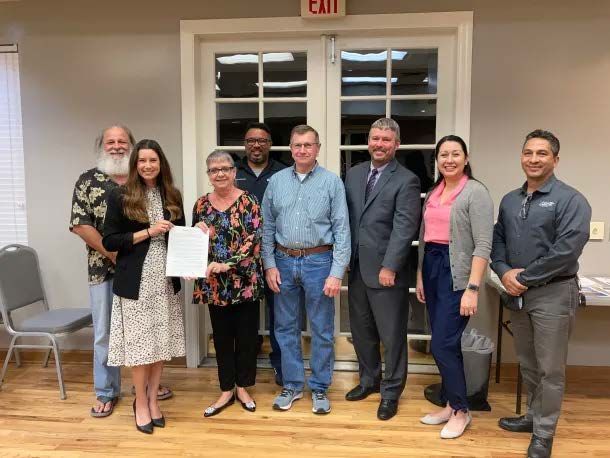
Town of Oakland Commissioner Mike Satterfield, BWCF’s Emily Bush, Mayor Kathy Stark, Commissioner Joseph McMullen, Commissioner Rick Pollard, City Manager Steve Koontz, FHWO’s Lesa Boettcher, and Commissioner Salvador Ramos.
When the coalition launched in January 2022, BWCF took on the role of facilitating it on behalf of its partners. The Foundation for a Healthier West Orange and the City of Ocoee had already brought the effort together, and Emily helped carry that momentum forward. She led the effort to secure formal resolutions of support from Winter Garden, Ocoee, Oakland, and Windermere, along with letters of support from partners like Gotha Rural Settlement, MetroPlan Orlando, and Orange County Parks. She also drafted the coalition’s first multi-year roadmap, helped organize its working groups, and began building a map of gaps and opportunities within the West Orange community to leverage funding entrusted by the foundation to deliver on that promise. The work is backed by $5.5 million entrusted to the Foundation for a Healthier West Orange and HWOTC by the West Orange Healthcare District, funding that also serves as seed money to attract additional investment in the region’s trails.
That investment is turning into real projects. Since 2022, the coalition has mapped trail gaps along the West Orange, finalized a priority network in 2025, and awarded four small project grants to partner communities. Recent highlights include $100,000 to the City of Ocoee for the first phase of a rail-to-trail conversion along Kissimmee Avenue and $100,000 to the Town of Windermere for landscaping along half a mile of the Ward Trail. In 2026, the coalition opened a new grant category for larger, ready-to-build projects, receiving its first application from the City of Winter Garden for a multi-use trail along East Plant Street, and launched a system-wide feasibility study to position the full network for regional and state funding.
For BWCF, HWOTC demonstrates what regional collaboration can accomplish. It brings communities and agencies together around a shared vision, helping bridge gaps in the trail network and connect places that might otherwise remain disconnected. This kind of collaboration creates more opportunities for everyday families, commuters, and neighbors to walk, bike, and roll between their communities and the places they go every day.
Setting a Course and Celebrating Community Champions
Rapid growth can pull a nonprofit in many directions at once. Emily made sure BWCF’s growth stayed intentional. She led two strategic planning cycles with the Board of Directors, setting seventeen goals that aligned the organization’s mission and vision with its fundraising and program efforts. Every new grant, partnership, and program had to move BWCF closer to safer streets for people who walk, bike, and roll.
BWCF completed all seventeen goals. Following through on every goal in a strategic plan takes discipline, and it required the board and staff to stay focused on the same priorities year after year. That record also gave funders and partners confidence that BWCF could deliver on its commitments.
Emily also helped launch the
Wheel of Achievement Awards, now one of BWCF’s signature events. The awards celebrate the projects, advocates, and community champions making streets, trails, and neighborhoods safer and more connected across Florida, from policy leaders and engineers to grassroots advocates and designers. Honorees are selected by a panel of experienced transportation, planning, and advocacy professionals who understand how hard it can be to change the way a community moves.
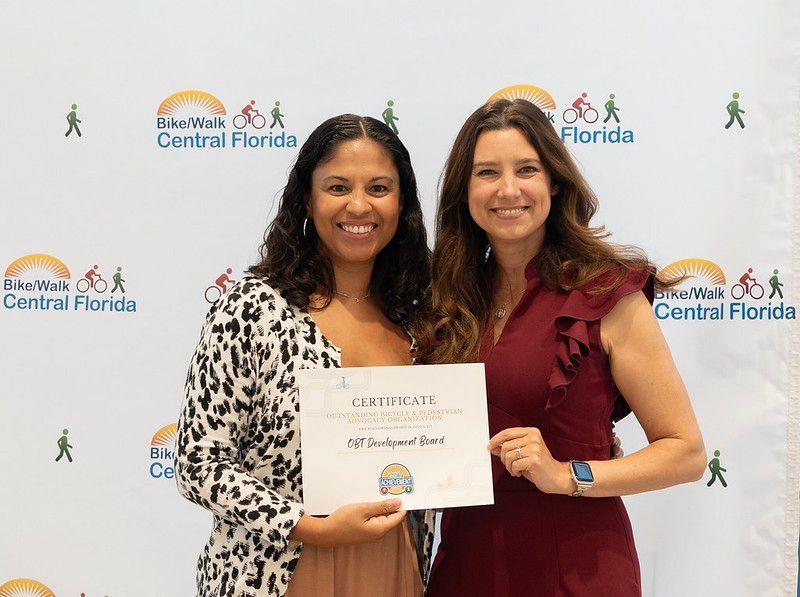
Jessia Darden (Program Specialist, OBT Development Board) and Emily Bush at the 2024 Wheel of Achievement Awards Ceremony.
Each year, the awards share these success stories with peers, partners, and decision-makers, encouraging them to take on similar work in their own communities. Since the first ceremony in 2023, the program has honored seventeen recipients whose work is helping shift culture, policy, and practice toward safer streets for everyone.
A Lasting Impact
When Emily stepped into the role in 2020, we were a small organization with big ambitions. Six years later, those ambitions have become programs, partnerships, and projects reaching communities across the region.
The numbers tell part of the story. The rest is harder to measure: a student who rides more confidently after a SAFE Travelers bike rodeo, a driver who now stops at the crosswalk, a city that puts trails in its long-term plan, and a coalition of communities working together to connect them. These are the changes that make streets safer, one person and one neighborhood at a time.
Emily built more than programs. She built relationships across the region, a team that holds itself accountable, and an organization strong enough to keep building on everything she started. For all of us at BWCF, and for everyone who walks, bikes, and rolls in Central Florida, thank you, Emily.