Rules of the Road
Whether you walk to school, bike to work, or roll through your neighborhood, understanding how to stay safe helps protect you and gives you confidence out there. Below are key laws and best practices for people walking, biking, rolling, and driving in Florida.
Pedestrian Laws & Safety
Walking safely isn’t just about knowing the rules; it’s about being seen, predictable, and aware of traffic around you.
Florida Crosswalk Laws
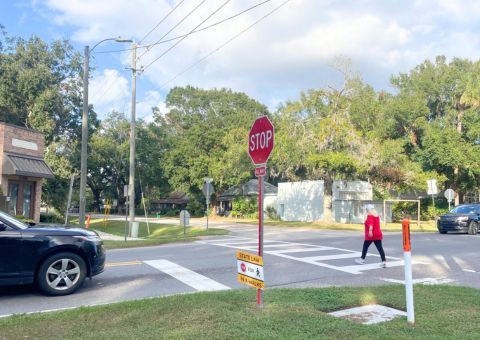
- Florida Law directs drivers to yield or stop for pedestrians "when the pedestrian is in the crosswalk or steps into the crosswalk and is upon the half of the roadway upon which the vehicle is traveling or when the pedestrian is approaching so closely from the opposite half of the roadway as to be in danger" -- F.S. Ch. 316 Sec. 130 (7)(a-c).
- At intersections with traffic signals, the driver must come to a complete stop when a pedestrian has a walk signal. -- F.S. 316.130(7)(a)
- At crosswalks without a traffic signal, the driver must come to a complete stop if signage so indicates; where signage does not indicate so, drivers must yield for the pedestrian by slowing down, or by stopping -- if necessary to so yield. -- F.S. 316.130(7)(b)(c)
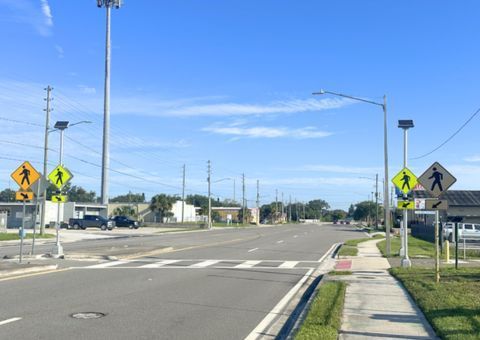
Using Sidewalks & Crossings
- Where sidewalks exist, pedestrians should use them.
- If sidewalks are unavailable, walk off the roadway and face oncoming traffic/vehicles.
- Cross at intersections or marked crosswalks whenever possible.
- If crossing mid-block cannot be avoided, pedestrians must yield right of way to vehicles on the roadway.
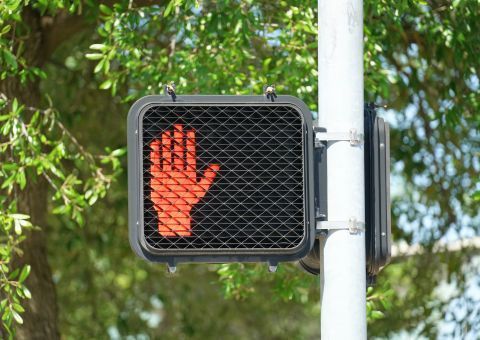
Pedestrian Signals
- Obey pedestrian signals where provided:
- Walking person (or "walk") means start crossing.
- Flashing raised hand (or "don't walk") means finish crossing if you've already started - do not start crossing.
- Solid raised hand (or "don't walk") means do not cross.
Bicycle Laws & Best Practices
Cycling plays an important role in how people move through Florida communities, both on streets and shared spaces.
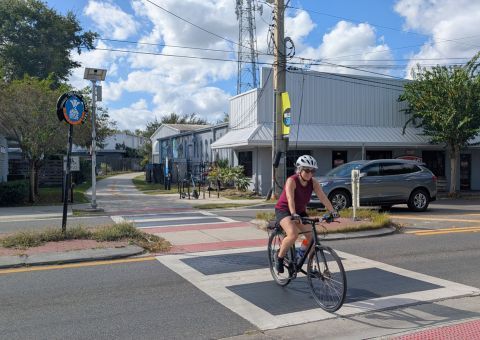
Where to Ride
- Bicyclists have the same rights and responsibilities as drivers on the road.
- Ride with traffic (same direction as vehicles), not against it.
- When available, use bike lanes or multi-use paths.
- Check local jurisdictions for restrictions on riding bikes on sidewalks.
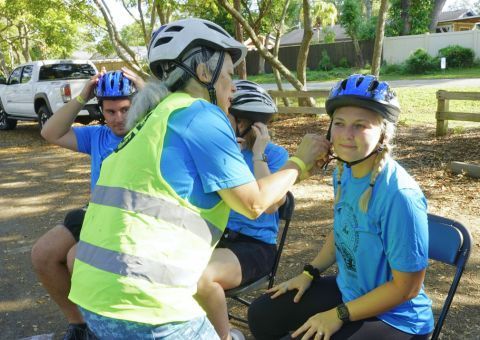
Helmet & Equipment Guidance
- Florida law requires helmets for bicyclists under the age of 16 --
F.S. 316.2065(3)(d). Helmets are strongly recommended for riders of all ages to reduce the risk of serious injury.
- Florida law requires bicycles to use a white front light and a red rear light or reflector when riding between dusk and dawn -- F.S. 316.2065(7).
Turning & Lane Position
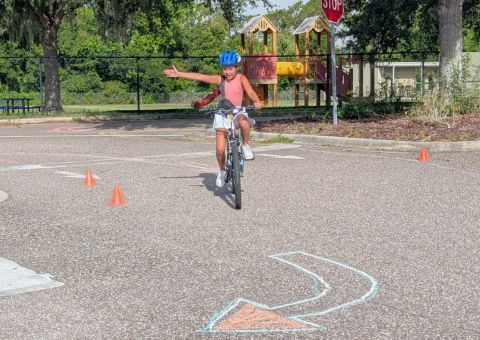
- Signal all turns and merge with traffic safely when preparing to turn.
- Ride in a straight line; don’t weave between parked cars.
- Use the leftmost lane that safely serves your destination when making left turns.
Sharing the Road
Everyone has a role in keeping streets safe. Streets work best when drivers, bicyclists, and pedestrians follow clear, shared expectations.
Safe Rolling Practices (Scooters, Skates, Etc.)
People using scooters, skates, wheelchairs, and other mobility devices also have responsibilities and protections when moving through streets and sidewalks.
Drivers & Bicyclists
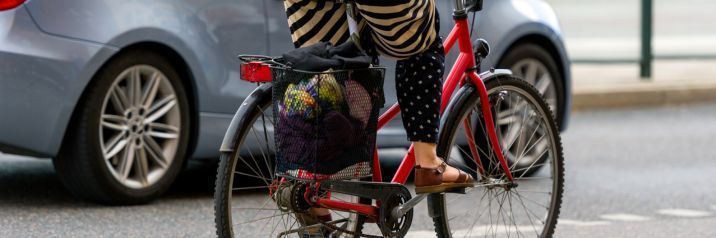
- Drivers should
give at least three feet of space when passing a bicyclist --
F.S. 316.083(2).
- Both drivers and cyclists should be predictable: signal turns, check over your shoulder before changing lanes, and respect traffic control devices.

Approaching Crosswalks
- Drivers must yield to pedestrians in crosswalks.
- Bicyclists should also yield to pedestrians and walk bikes across crosswalks if needed for safety.

Sidewalks & Streets
- Follow the same direction of traffic and obey the same basic rules as bicycles when on the road.
- Where sidewalk rolling is allowed, be courteous and yield to pedestrians.
- When travelling along a sidewalk or in a crosswalk, bicyclists must yield to pedestrians and provide an audible signal before passing pedestrians. -- F.S. 316.2065(10)
- Check local jurisdictions for restrictions on riding on sidewalks.
Signals & Awareness
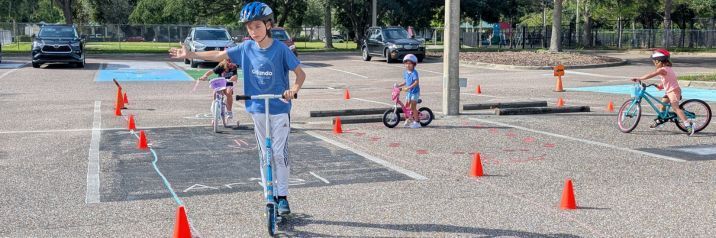
- Use hand signals or natural body language to show your intent.
- Stay visible, especially at night, with lights and reflective gear.
Sharing the Road
Everyone has a role in keeping streets safe. Streets work best when drivers, bicyclists, and pedestrians follow clear, shared expectations.
Safe Rolling Practices (Scooters, Skates, Etc.)
People using scooters, skates, wheelchairs, and other mobility devices also have responsibilities and protections when moving through streets and sidewalks.
Safety Tips You Can Use Every Day
Be Visible
- Wear bright or reflective clothing.
- Use lights at dawn, dusk, and night.
Be Predictable
- Follow traffic laws.
- Make eye contact with drivers, pedestrians, and other road users.
Be Aware
- Avoid earbuds or phone distractions.
- Scan ahead for potential hazards.
Ready to Put This Into Practice?
Understanding the rules of the road is one step toward safer streets. If you want to take action, whether that’s improving conditions in your neighborhood, supporting safety efforts, or learning how to get involved, there are ways to move forward.
Related Resources
Looking for what’s next? These resources can help you explore more routes and take action to support safer walking, biking, and rolling in your community.
Trails, Maps, & Routes
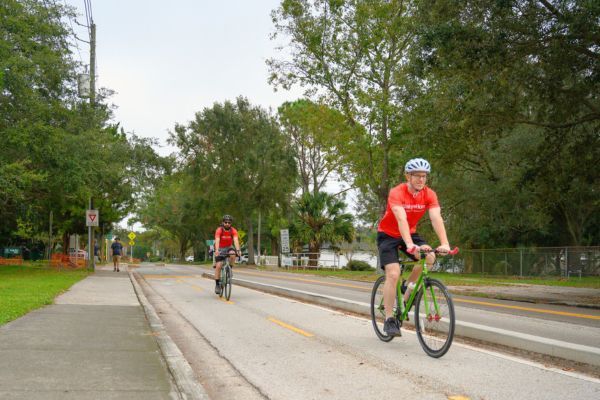
Discover trail maps and route resources, and explore how local trails and streets connect.
Advocacy & Community Action
Get involved in local efforts to create safer, more connected streets.